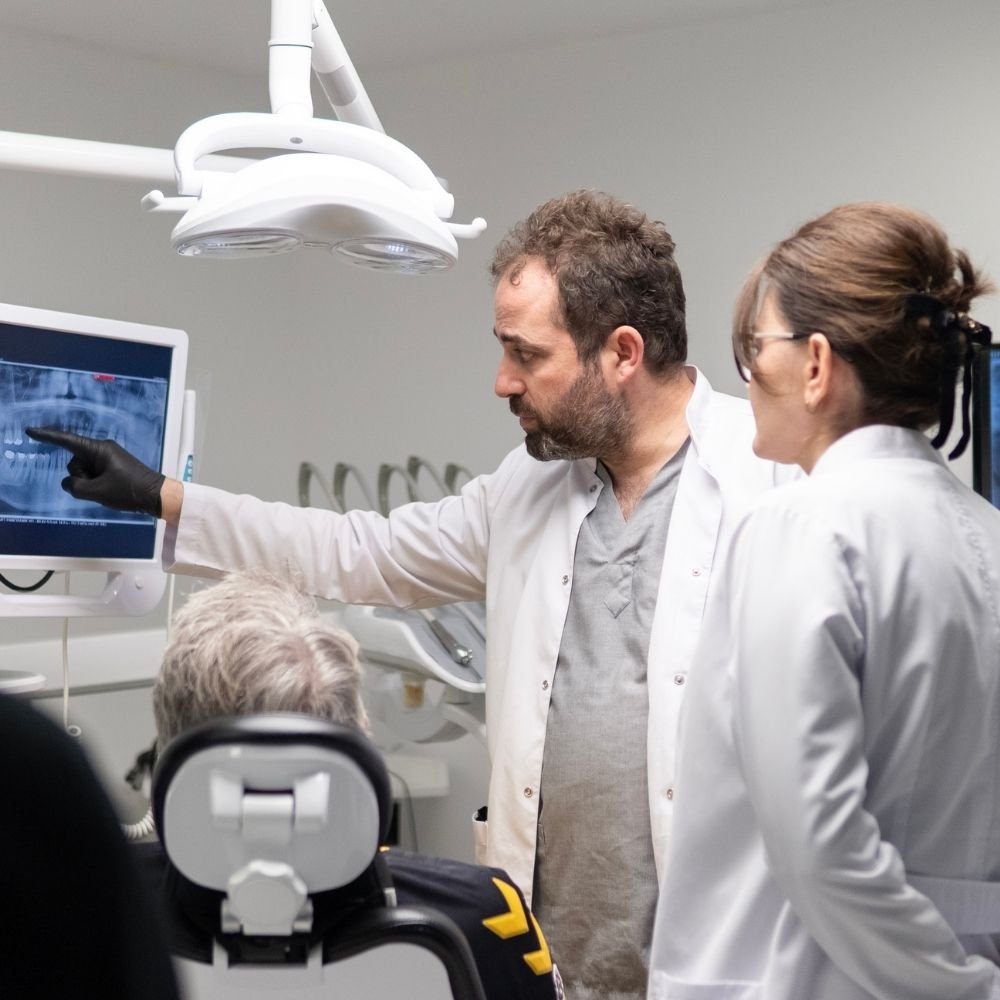

If you are missing most or all of your teeth — or facing the prospect of losing them — All-on-4 and All-on-6 dental implants are two of the most life-changing solutions available. Both involve replacing an entire arch of teeth with a fixed, permanent prosthesis supported by implants. Both can be completed in a single trip abroad. And both cost a fraction of the equivalent UK price when carried out at a reputable clinic in Turkey.
But they are not the same procedure, and for many patients, one is significantly more suitable than the other. This guide explains exactly what sets them apart — candidacy, bone requirements, cost, long-term stability and the situations where each option excels.
The basics: what do All-on-4 and All-on-6 actually mean?
Both treatments replace all the teeth in one arch (upper or lower jaw) with a fixed bridge supported by implants screwed directly into the jawbone. The difference is in the number of implants used to support that bridge.
All-on-4 uses four implants per arch. Two are placed vertically at the front of the jaw, and two are angled at up to 45 degrees at the back. The angled placement allows the rear implants to access denser bone further forward in the jaw, avoiding the need for bone grafting in many cases.
All-on-6 uses six implants per arch, typically all placed vertically. The additional two implants provide more distribution points for the load of the prosthesis, which can mean greater long-term stability — particularly for patients with a stronger bite or those who have adequate bone volume.
Side-by-side comparison
| All-on-4 | All-on-6 | |
| Number of implants | 4 per arch | 6 per arch |
| Implant placement | 2 vertical + 2 angled (up to 45°) | All vertical |
| Bone graft usually needed? | Often not — angled placement avoids thin bone zones | Occasionally — depends on bone density |
| Best suited for | Moderate bone loss, budget-conscious patients | Good bone volume, heavier bite force |
| Load distribution | Good — angled implants spread force effectively | Excellent — more points of contact |
| Long-term stability | Very good | Excellent |
| Cost in Turkey (per arch) | £3,500 – £6,000 | £4,500 – £8,000 |
| Cost in UK (per arch) | £12,000 – £20,000 | £15,000 – £24,000 |
| Treatment timeline | 5–7 days for surgery + temps; return for finals | 5–7 days for surgery + temps; return for finals |
Who is a good candidate for All-on-4?
All-on-4 was specifically developed to serve patients who have experienced significant bone loss — which is common after years of missing teeth, gum disease or wearing dentures. Because the rear implants are angled, they can reach areas of denser bone without the need for bone grafting in the majority of cases. This makes All-on-4 a viable option for patients who might otherwise have been told they do not have enough bone for implants.
All-on-4 is typically well suited for patients who:
- Have moderate to significant bone loss in the jaw
- Want to avoid bone grafting procedures, which add time and cost
- Are replacing an entire arch (upper, lower or both)
- Have a moderate bite force
- Are seeking the most cost-effective full-arch solution
Important: Even with All-on-4, a 3D CBCT scan is essential before treatment planning. No reputable clinic should confirm your suitability for any implant procedure without one.
Who is a good candidate for All-on-6?
All-on-6 is typically the preferred option when bone volume and density are sufficient to support six vertically placed implants. The additional implants distribute the load of the prosthesis across more contact points, which can be advantageous for patients with a strong bite, those replacing larger or heavier prostheses, or patients who want the maximum possible long-term stability.
All-on-6 tends to be recommended for patients who:
- Have good bone density and sufficient jaw volume
- Have a heavier or stronger bite
- Prioritise maximum long-term stability over cost
- Are replacing the upper arch, where bone density is naturally lower and additional support points help
- Have already had bone grafting to restore lost volume
What does the treatment involve?
The treatment process is broadly similar for both options and can typically be completed with two visits to Turkey.
First visit (5–7 days)
Your CBCT scan and assessment are reviewed, and a detailed treatment plan is confirmed. On the day of surgery, any remaining failing teeth are extracted if needed, and the implant fixtures are placed. A temporary prosthesis — often called ‘teeth in a day’ — is fitted immediately, so you leave surgery with a full set of functional teeth. You spend several days in Antalya recovering before flying home.
Healing period (4–6 months)
The implants integrate with the jawbone during this period. You wear your temporary prosthesis throughout, which is fully functional. Most patients return to normal eating and speaking within a few weeks of surgery.
Second visit (3–4 days)
Your final prosthesis — typically a full-arch zirconia bridge — is manufactured, fitted and adjusted. This is the permanent set of teeth you will leave with.
Which one should you choose?
The honest answer is that the decision should be made by your specialist after reviewing your CBCT scan, not before. The scan reveals the actual density and volume of your bone, which is the primary determining factor.
As a general guide: if bone loss is significant and you want to avoid grafting, All-on-4 is likely the more practical starting point. If you have adequate bone volume and want the maximum stability and load distribution, All-on-6 is worth the additional investment.
At DentArma, we do not recommend a specific option before reviewing your imaging. What we can tell you is that both procedures, performed by an experienced prosthodontist using premium implant fixtures, produce life-changing results — and that the cost in Turkey represents a saving of £8,000–£16,000 compared to equivalent UK treatment.
From a patient: I had All-on-6 in both arches. The professor and his team are perfectionists at what they do. I left with a perfect smile and would not hesitate to recommend DentArma to anyone. — Sheena D., Trustpilot
Frequently asked questions
Can I eat normally with All-on-4 or All-on-6 implants?
Yes — once the final prosthesis is in place, you can eat most foods comfortably. During the healing period you will follow a soft-food diet to protect the implants while they integrate. Your specialist will provide specific dietary guidance for each stage.
How long do All-on-4 and All-on-6 implants last?
With proper care and maintenance, the implant fixtures can last a lifetime. The prosthesis itself — the bridge — typically lasts 15–20 years before it may need replacing, depending on wear and maintenance.
What is the difference in cost between All-on-4 and All-on-6 in Turkey?
At DentArma, All-on-4 treatment per arch starts from £3,500, and All-on-6 from £4,500. The exact cost depends on your specific case, the materials used and any additional procedures required. Contact us via WhatsApp for a personalised quote based on your X-rays.
Do I need bone grafting for All-on-4?
In many cases, no — which is one of the key advantages of All-on-4. The angled rear implants reach areas of denser bone that avoids the regions most affected by resorption. However, some patients do require grafting, and this can only be confirmed after a CBCT scan.
Related treatments
- All-on-4 Dental Implants in Turkey — dentarma.com/all-on-4-dental-implants-in-turkey/
- All-on-6 Dental Implants in Turkey — dentarma.com/all-on-6-dental-implants-in-turkey/
- Full Mouth Dental Implants — dentarma.com/full-mouth-dental-implants-in-turkey/
Get a free assessment
Send us your X-rays or a CBCT scan via WhatsApp and our specialist team will assess whether All-on-4 or All-on-6 is the better option for your case — completely free, with no obligation.